Concrete Repair, Learning Center
Why Choose an epoxy patch over traditional concrete?
Jul
Concrete is one of the strongest building materials available, but it isn’t indestructible. Heavy traffic, freeze-thaw cycles, chemical exposure, impact damage, and years of wear eventually lead to cracks, spalling, and surface deterioration.
When that happens, many people automatically reach for a bag of concrete mix. While that may be suitable for some applications, there are many situations where an epoxy patch provides a stronger, longer-lasting repair.
Superior Bond Strength
Traditional cement-based repair materials rely primarily on mechanical adhesion to stay in place. Over time, vibration, heavy traffic, or moisture can cause these repairs to loosen or fail.
Epoxy patching compounds chemically bond to properly prepared concrete, creating an exceptionally strong repair that is far less likely to separate from the surrounding slab.
Greater Durability
Industrial floors are subjected to forklifts, pallet jacks, steel wheels, heavy equipment, and constant traffic. Cement repairs can wear away over time, especially in high-use areas.
A quality epoxy patch offers:
- Outstanding compressive strength
- Excellent impact resistance
- Superior abrasion resistance
- Long service life in demanding environments
For facilities where downtime is expensive, durability matters.
Outstanding Chemical Resistance
Concrete naturally absorbs water, oils, and chemicals. Over time, exposure to salts, fuels, oils, acids, and cleaning chemicals can weaken conventional repairs.
Epoxy repairs resist many of the chemicals commonly found in:
- Manufacturing facilities
- Breweries
- Food processing plants
- Parking garages
- Wastewater facilities
- Marinas
- Maintenance shops
This makes epoxy an ideal solution anywhere concrete is exposed to harsh conditions.
Reduced Downtime
Replacing concrete often means shutting down operations for several days—or even weeks—while new concrete cures.
Many epoxy repair systems can be returned to service much faster, allowing repairs to be completed overnight or during scheduled maintenance windows. That means less disruption and lower operating costs.
No Shrinkage During Cure
Many epoxy repair compounds are formulated with 100% solids and exhibit minimal shrinkage during curing. When properly installed, this helps maintain a strong bond with the surrounding concrete and reduces the risk of premature repair failure.
Excellent for Partial Repairs
If the surrounding concrete is structurally sound, there is often no reason to remove and replace an entire slab.
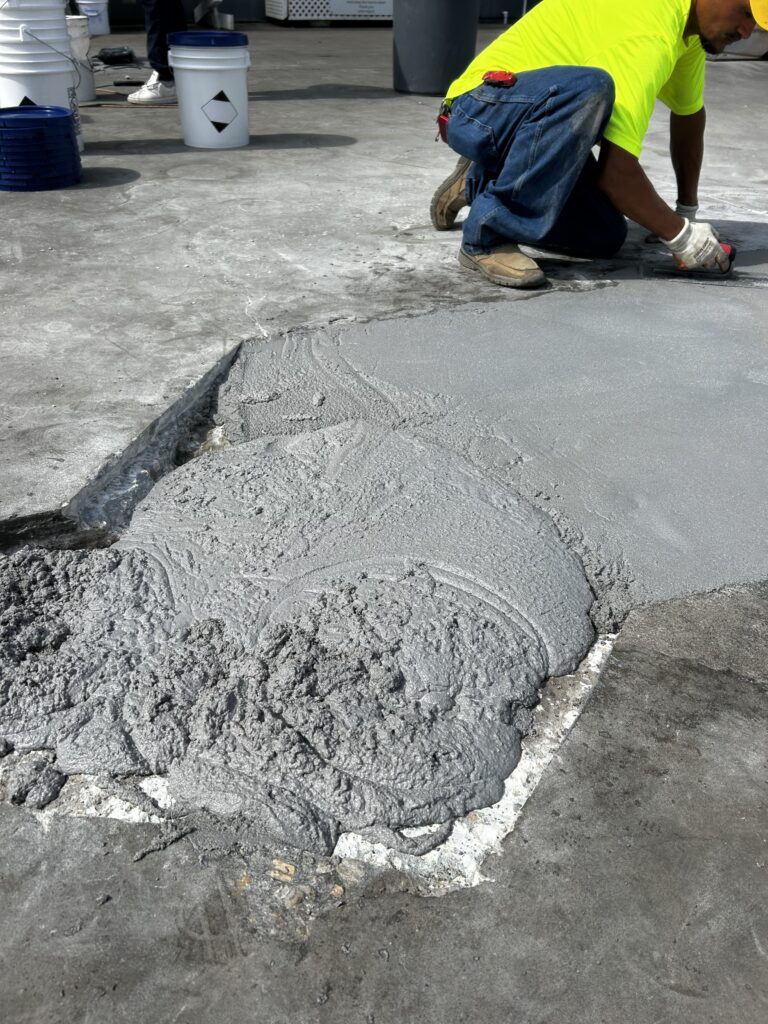
An epoxy patch allows damaged sections to be repaired while leaving the rest of the concrete intact. This can significantly reduce labor, material costs, and downtime.
Repairing Damaged Industrial Concrete Floors
Industrial concrete floors are exposed to demanding conditions, including forklift traffic, pallet jacks, heavy equipment, chemical spills, and repeated loading. Over time, these conditions can contribute to cracks, spalling, chipped edges, surface deterioration, and worn concrete.
Common areas requiring repair include warehouse floors, manufacturing facilities, loading docks, equipment maintenance areas, and industrial workspaces.
When the underlying concrete remains structurally sound, an epoxy concrete repair compound may provide an effective alternative to removing and replacing an entire section of flooring.
The appropriate repair method depends on the depth and extent of the damage, operating conditions, surface preparation, and the time available before the floor must return to service.
Epoxy Patching vs. Concrete Resurfacing: Which Should You Use?
Not every damaged concrete floor requires the same type of repair.
Epoxy Concrete Patching: For localized damage such as holes, spalled areas, chipped surfaces, and deteriorated sections, an epoxy patching compound can rebuild the affected area. Dynamis EPO Patch & Grout is designed for industrial concrete patching and repair applications.
Epoxy Concrete Resurfacing: When larger sections of concrete are worn, uneven, or deteriorated, resurfacing may be more appropriate than repairing individual spots. Dynamis Resurfacer LTC is designed for restoring concrete surfaces and provides a more textured finish than EPO Patch & Grout.
Proper surface preparation is essential for either approach. Concrete should be sound, clean, and prepared in accordance with the selected product’s technical instructions. Structural movement, unstable substrates, or significant slab damage may require professional assessment before repairs begin.
When Is Concrete the Better Choice?
Epoxy is not the answer for every repair.
Traditional concrete replacement is usually the better option when:
- The slab has major structural failure.
- Large sections have settled or shifted.
- The concrete base has been undermined.
- Extensive cracking indicates foundation movement.
In these situations, correcting the underlying structural issue should come before cosmetic or surface repairs.
The Dynamis Difference
At Dynamis Epoxy, we’ve been manufacturing professional-grade epoxy repair products for decades. Our EPO Patch & Grout was developed specifically for demanding industrial environments where conventional concrete repairs simply don’t last. The pre-measured three-component system combines epoxy resin, hardener, and kiln-dried, properly graded silica aggregate to eliminate guesswork and deliver consistent performance.
Whether you’re repairing a warehouse floor, marina, loading dock, processing plant, parking garage, or industrial facility, choosing the right repair material can save both time and money over the life of the concrete.
A properly installed epoxy repair doesn’t just fill a hole—it restores strength, resists wear, and helps keep your facility operating with minimal interruption.
For localized concrete damage, including holes, chipped surfaces, and spalled areas, explore our EPO Patch & Grout. For larger worn or deteriorated concrete surfaces, consider Resurfacer LTC. You can also browse our complete selection of Industrial Concrete Repair Products to find the appropriate solution for your application.
Need help selecting the right repair product? Contact the team at Dynamis Epoxy. We’ll help you choose the best solution for your specific application.